By Sue Palmer, The Horse Physio
Prefer to listen? Click on the video above. If you enjoy reading, keep scrolling. You can support my work by buying me a coffee, joining the Healthy Humans, Happy Horses online learning hub, or signing up to my newsletter. Remember to follow, like, and share on Facebook, Instagram and YouTube. Please note that this may contain affiliate links. Thank you – your support means so much!
I was recently informed that The Horse Physio has been recognised in the SME Business Elite Awards as the Leading Equestrian Physiotherapist 2025 – Staffordshire. I’m delighted to receive this recognition, particularly as it highlights the importance of physiotherapy in helping both horses and humans feel and function at their best.
Awards aren’t the focus of my work, but they do offer a welcome moment to pause — to consider the partnerships I’ve supported, the horses who have trusted me with their comfort, and the many people who care so deeply about doing the right thing for their equine partners.
For me, it all comes back to the same passion that has guided my career from the start: supporting well-being, promoting prevention, and helping horses and humans live and move in greater comfort and harmony.
Physiotherapy for horses is far more than a treatment you wheel out when “something’s gone wrong.” In fact, it works best long before that point. Horses are masters of quiet communication — of subtle shifts in movement, expression, and behaviour that tell us everything we need to know if we’re willing to look.
Over the years, I’ve seen again and again that these early signs often reflect one of three things:
Brain, Pain or Training.
That’s the heart of one of my books, and it’s also the heart of my day-to-day work. Physiotherapy sits right in that space — understanding the body, observing behaviour, detecting pain, and helping owners make thoughtful decisions before a small issue becomes a crisis.
Some of the most rewarding moments in my career haven’t been dramatic “fixes” at all. They’ve been gentle, sometimes almost unnoticeable shifts — the pony who suddenly loads without hesitation; the horse who discovers he can canter comfortably on the rein he previously resisted; the older cob who rolls joyfully again in the field because his back no longer hurts.
These moments remind me that the work isn’t about performance levels or competition results. It’s about comfort, confidence, and quality of life — for the horse, and for the partnership.
People are often surprised that I work with both horses and humans. For me, it’s always been obvious. You can’t separate the two. The horse feels the rider’s body with every stride — long before the rider is aware of how they’re sitting, gripping, bracing, compensating, or carrying tension.
A tight hip alters your seat.
A stiff spine changes your weight distribution.
Fatigue — something so many middle-aged equestrians quietly battle — affects balance, timing, confidence, and communication.
Emotional stress? Horses pick that up faster than we do.
Supporting the rider’s body is just as important as supporting the horse’s. When you feel stronger, more stable, and more at ease in your own movement, your horse feels that clarity and consistency immediately.
As a single mum running my own business, caring for my son, and looking after my dog Lily and my cat JJ, I understand deeply how precious our bodies and energy levels are. Many of the riders who come to see me are holding far more on their shoulders than they ever admit — family pressures, work commitments, caring responsibilities, the emotional weight of keeping a horse well.
Physiotherapy offers a moment of relief, but also a moment of resetting — a space where your health and well-being matter, too.
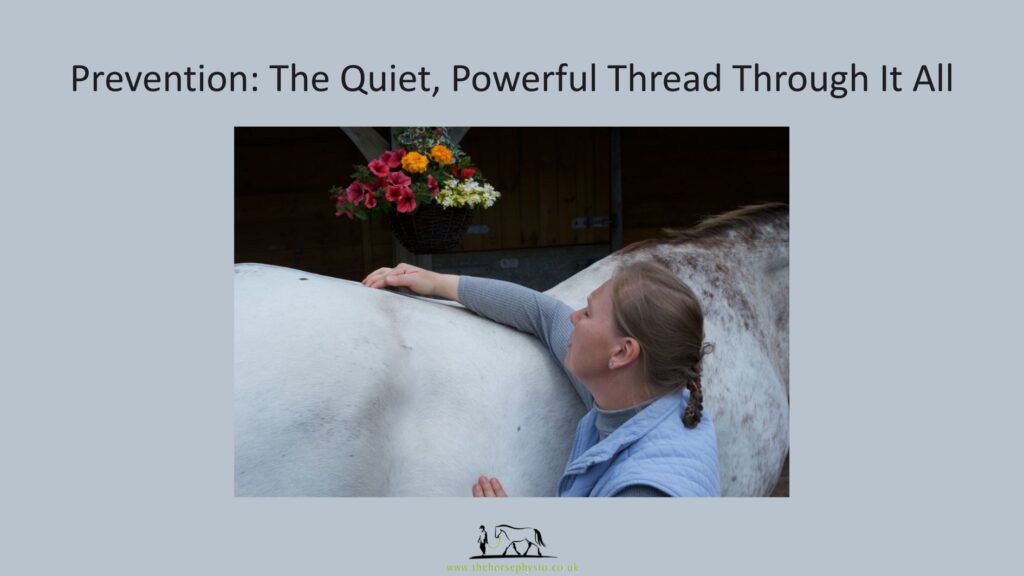
If there’s one message I wish I could share with every horse owner, it’s this:
Prevention is always kinder — to your horse, to your wallet, and to your peace of mind.
This isn’t about finding problems. It’s about giving your horse the best chance of staying well. Regular check-ups, small adjustments, consistent observation, thoughtful management — these create a foundation that supports everything else you do together.
And the same principle applies to us.
If we don’t look after our own health, we simply can’t be there fully for our horses. We can’t ride well if we’re in pain. We can’t make good decisions when we’re exhausted. We can’t create harmony when our nervous system is on high alert.
Taking care of ourselves isn’t indulgent.
It’s essential.
For us — and for our horses.
Although my name appears on the award, it really belongs to the horses and humans who have allowed me to walk beside them — sometimes for many years.
To every rider who has trusted me with their own well-being…
To every owner who has invited me into the stable, the arena, the muddy gateway, or the grooming area…
To every horse who has allowed me to listen, explore, and understand their body with kindness…
Thank you. I’m endlessly grateful.
This work is a privilege. The recognition is simply a reminder of how much it matters.
If you enjoy learning gentle, evidence-aware, prevention-focused insights for both horses and humans, you’re very welcome to join my newsletter community.
It’s a calm, compassionate space — with no pressure, no judgement — just thoughtful weekly reflections to support you and your horse.
You can sign up here.
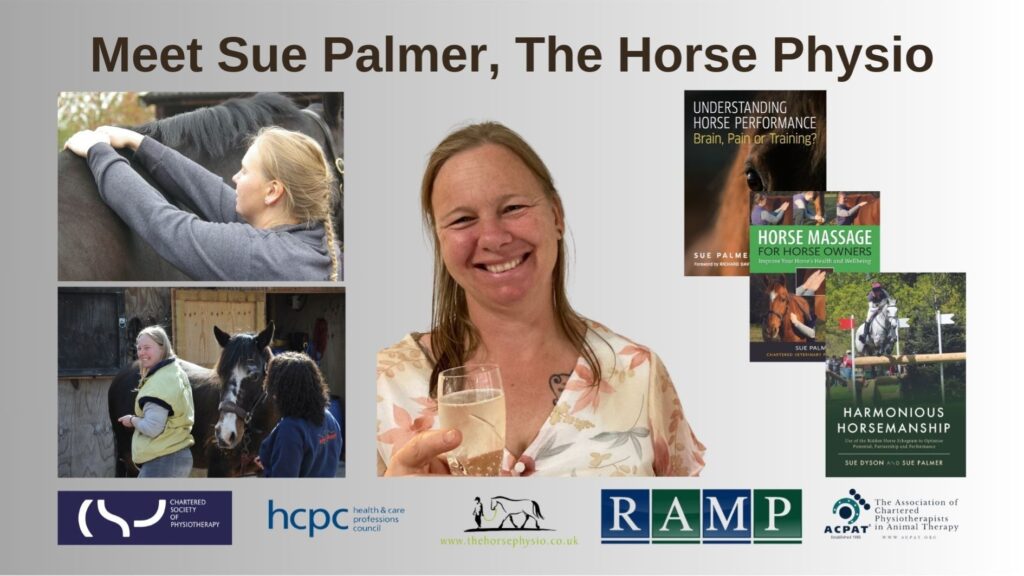
🌟 About Sue Palmer, The Horse Physio
Sue Palmer MCSP is an award-winning Chartered Physiotherapist, educator, and author. Known for her compassionate, evidence-informed approach, Sue specialises in human health and equine well-being, with a focus on the links between pain and behaviour in horses. She is registered with RAMP, ACPAT, IHA, CSP, and HCPC.
📚 Books include:
Harmonious Horsemanship (with Dr Sue Dyson)
Understanding Horse Performance: Brain, Pain or Training?
Horse Massage for Horse Owners
Drawn to Horses (with illustrations by Sarah Brown)
🌐 Learn more at www.thehorsephysio.co.uk