Prefer to listen? Click on the video below. If you enjoy reading, keep scrolling. You can support my work by signing up to my newsletter. Remember to follow, like, and share on Facebook, Instagram and YouTube. Please note that this may contain affiliate links. Thank you – your support means so much!
There are many ways we try to care for our horses. We manage their routines, think carefully about tack, training and workload, and call on professionals when something doesn’t feel right. But sometimes, the most powerful thing we can do is also the simplest: slow down, place our hands on our horse, and listen.
That’s the thinking behind my Horse Massage Mini Masterclass.
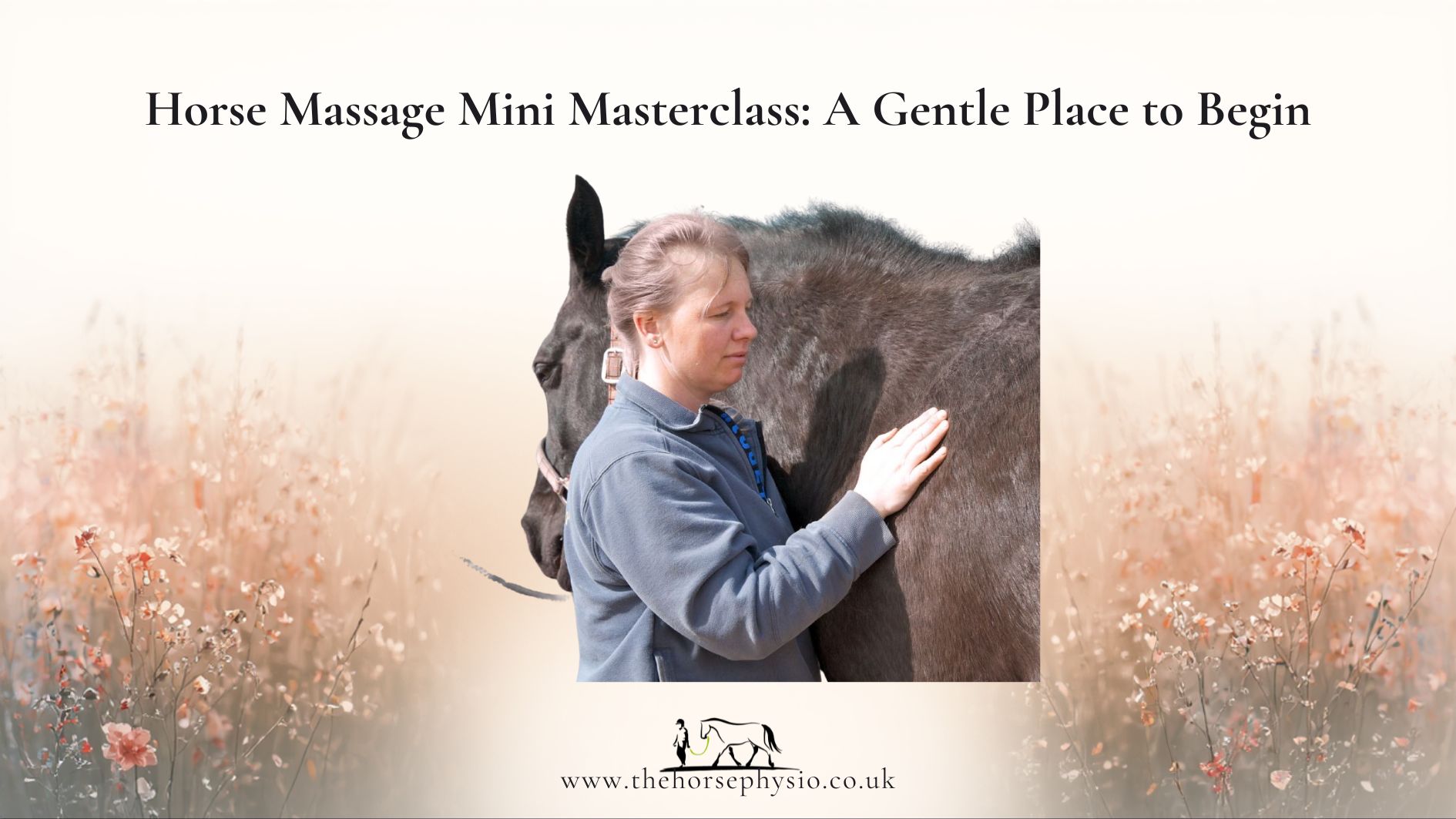
It isn’t about fixing, diagnosing, or doing things “right”. It’s about creating a calm, thoughtful space where you can begin to understand how your horse’s body feels, how they respond to touch, and what that might be telling you.
If that sounds like something you’d like to explore, you can join the free mini masterclass here.
Why touch matters
Touch is one of the most fundamental forms of communication in mammals. Long before we have language, we understand the world through physical contact. Research in humans has shown that gentle, non-threatening touch can reduce stress, lower heart rate, and influence levels of hormones such as oxytocin, often associated with bonding and relaxation.
Similar effects have been observed in animals. Studies exploring human–animal interaction have found that calm stroking can reduce physiological markers of stress in both the animal and the person involved. In horses, gentle handling and grooming have been shown to influence heart rate variability and behavioural indicators associated with relaxation.
What’s important here is not the exact mechanism, but the message: touch matters. When used thoughtfully, it can support calmness, connection, and awareness — for both horse and human.
Massage as listening, not doing
One of the biggest misunderstandings about massage is that it’s something we do to a horse. In reality, the most valuable aspect of massage is often what it teaches us to notice.
In the Horse Massage Mini Masterclass, we focus on three key areas of the body: the back, the neck, and the quarters. These are not chosen because they are the only areas that matter, but because they are common places where tension can show up and where owners often notice changes in comfort or movement.
Each day of the mini masterclass introduces one area, with a short video and gentle guidance. You’re invited to observe how your horse responds to pressure, to notice areas of ease or sensitivity, and to work slowly, using simple effleurage strokes.
There is no expectation that you will “release” anything, improve performance, or see dramatic change. The intention is much quieter than that. It’s about building a baseline understanding of what feels normal for your horse.
What owners often notice
When people begin to use their hands more consciously with their horse, they often tell me they start to notice small but meaningful things:
None of these observations, on their own, diagnose a problem. But together, over time, they build a picture. And that picture can be incredibly helpful when you’re making decisions about workload, management, or when to involve a professional.
Massage doesn’t replace veterinary or physiotherapy care. Instead, it supports early awareness — and early awareness is one of the most powerful tools we have in safeguarding comfort and welfare.
Benefits for the human, too
It’s also worth saying that this process isn’t just beneficial for horses.
Research on human–animal interaction has consistently shown that spending calm, focused time stroking or grooming animals can reduce stress and promote emotional wellbeing in people. Many horse owners instinctively know this already. There’s something grounding about standing quietly with a horse, breathing a little more slowly, and letting the outside world drop away for a few minutes.
In a profession where I work with both horses and humans, I see this time and again. These moments of quiet connection matter. They support confidence, empathy, and trust — not just in the horse, but in ourselves.
A gentle introduction, not a commitment
The Horse Massage Mini Masterclass is deliberately small. Three short emails. Three short videos. No pressure to continue, no expectation to sign up for anything else.
Some people take the mini masterclass and stop there, simply using what they’ve learned as part of their regular care. Others decide they’d like to explore massage in more depth. Both are absolutely fine.
If you’d like to take part, you can sign up here.
A final thought
Good horse care isn’t about doing more and more things. Often, it’s about doing a few things more thoughtfully.
Taking a few quiet minutes to place your hands on your horse, notice their responses, and listen without judgement can make a real difference over time. You don’t need to be perfect. You don’t need to know all the answers.
You just need to begin.
If this piece resonates with you, you’re very welcome to share it with friends, riding clubs, or horse-loving communities who might benefit from a gentle introduction to horse massage. One of the reasons I created the Horse Massage Mini Masterclass was to support people in areas where access to hands-on professionals is limited, and sharing helps this work reach further than I ever could on my own.

Sue Palmer | The Horse Physio
Chartered Physiotherapist supporting horses and humans.
Author • Educator • Evidence-informed care.