By Sue Palmer, The Horse Physio
Prefer to listen? Click on the video above. If you enjoy reading, keep scrolling. You can support my work by buying me a coffee, joining the Healthy Humans, Happy Horses online learning hub, or signing up to my newsletter. Remember to follow, like, and share on Facebook, Instagram and YouTube. Please note that this may contain affiliate links. Thank you – your support means so much!
I was reading an article on BBC News recently that made me pause — not because it told us to do more, but because it gently challenged the idea that more is always better when it comes to exercise.
In a world that often encourages us to push harder, train longer, and optimise every spare minute, the findings felt quietly reassuring.
The research followed more than 110,000 people over several decades and explored how different patterns of physical activity related to long-term health outcomes. Two themes stood out clearly, and they align closely with what I see in practice as a physiotherapist.
Variety matters more than intensity alone
One of the strongest findings was that people who moved their bodies in different ways tended to do better than those who focused on just one form of exercise.
Walking, strength work, stretching, cycling, swimming, yoga, gardening — each offers something different. Some challenge the cardiovascular system, others support joint health, balance, coordination, or muscle strength. Some help us regulate stress or sleep better. Others simply allow us to be outdoors, breathe, and feel more connected to our bodies.
From a physiological point of view, this makes complete sense. The human body adapts best when it’s exposed to a range of stimuli rather than repeated stress in the same pattern. From a behavioural perspective, variety also tends to be more sustainable. We’re far more likely to keep moving if movement fits into our lives rather than dominating them.
There appears to be a “sweet spot”
The second finding that caught my attention was that the health benefits of exercise seemed to level off beyond a certain point.
The greatest benefits were seen at around six hours of moderate-intensity activity per week, or around three hours of more vigorous exercise. Importantly, this doesn’t mean that exercising more is harmful — simply that the curve flattens. Beyond that level, the additional gains are smaller.
Again, this feels important. For many people, exercise has become something they feel they are failing at. Targets feel unrealistic. Guilt creeps in when life inevitably gets in the way.
This research offers a different narrative: enough really can be enough.
My own experience — and honesty
I’m sharing this not as someone who finds exercise easy or automatic, but as someone who has just as many reasons not to prioritise it as anyone else.
Time, fatigue, competing responsibilities, and the tendency to focus on what feels urgent rather than what benefits future health — these are all very real challenges. I see them in clients every day, and I experience them myself.
At the start of this year, I made a quiet commitment to move more consistently. Not dramatically. Not perfectly. Just consistently.
At the moment, I’m aiming for around three to four hours of moderate activity each week, alongside about an hour and a half of more vigorous exercise. In practice, that looks like daily walking — usually 20 to 30 minutes, with a longer walk at the weekend — plus short HIIT sessions spread across the week.
I’m genuinely proud of myself for maintaining that.
What I also know is how fragile new habits can be. Life always gets busy. Something else always demands attention. Exercise is one of those things that benefits our future selves far more than our immediate ones, which makes it surprisingly hard to prioritise — even when we understand the evidence.
Why this matters
From a physiotherapy perspective, movement is not about chasing fitness trends or hitting arbitrary targets. It’s about supporting the body you live in, over time.
Regular, varied movement supports joint health, muscle strength, bone density, cardiovascular function, balance, coordination, and mental wellbeing. It also supports resilience — physical and psychological — which becomes increasingly important as we age.
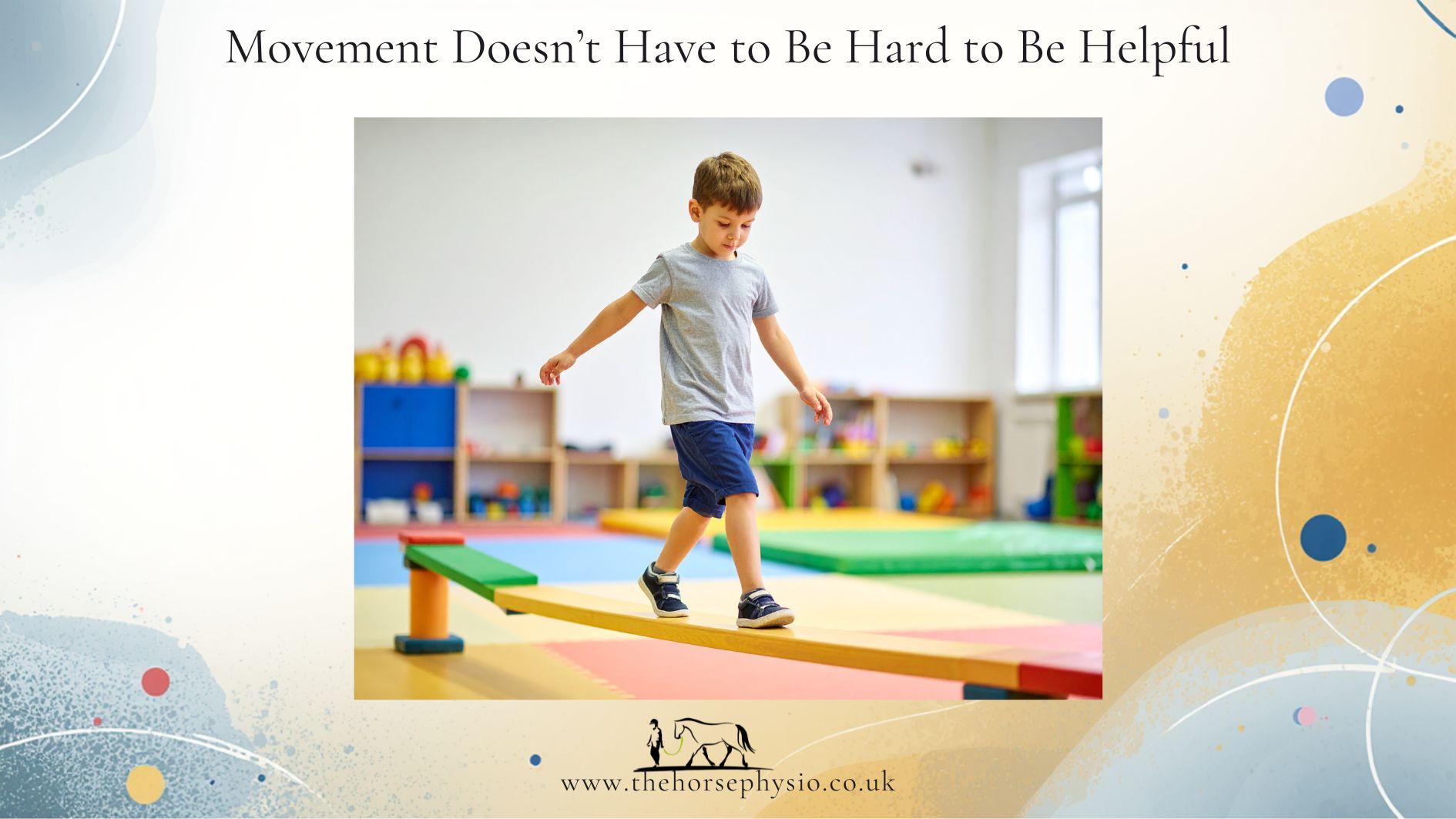
Crucially, movement does not need to be extreme to be effective. It needs to be regular, varied, and realistic.
A gentle nudge, not a demand
If you’re reading this and thinking you might not be doing quite enough at the moment, I hope this doesn’t feel like criticism.
Perhaps it’s simply a kind nudge to reflect on what a little more might look like for you. Not all or nothing. Not perfection. Just one small, sustainable step.
Sometimes that’s how change actually sticks.

🌟 About Sue Palmer, The Horse Physio
Sue Palmer MCSP is an award-winning Chartered Physiotherapist, educator, and author. Known for her compassionate, evidence-informed approach, Sue specialises in human health and equine well-being, with a focus on the links between pain and behaviour in horses. She is registered with the RAMP, ACPAT, IHA, CSP, and the HCPC.
📚 Books include:
Harmonious Horsemanship (with Dr Sue Dyson)
Drawn to Horses (hardback, with illustrations by Sarah Brown)
Understanding Horse Performance: Brain, Pain or Training? (ebook)
Horse Massage for Horse Owners (ebook)
🌐 Learn more at www.thehorsephysio.co.uk